
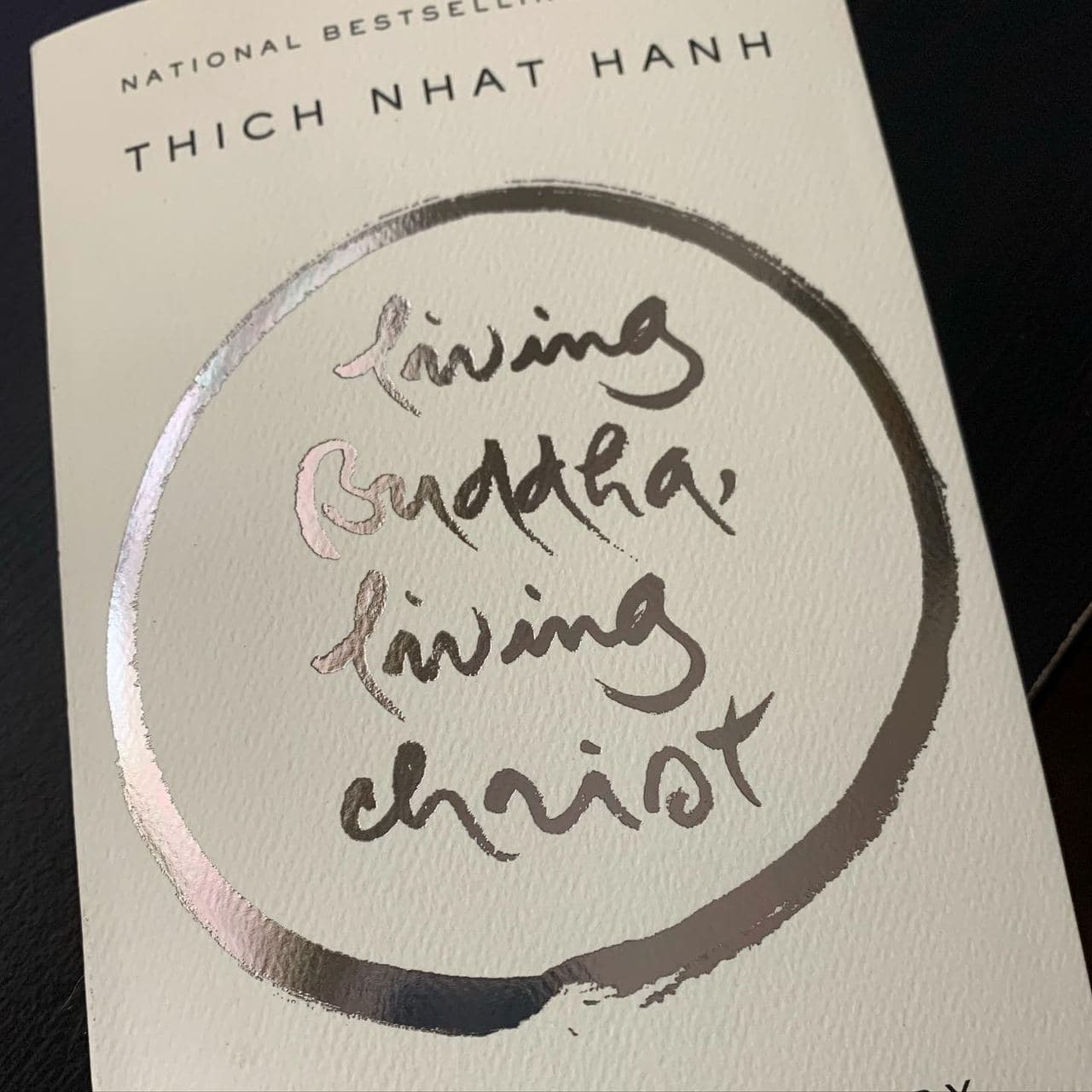
“Our capacity to make peace with another person and with the world depends very much on our capacity to make peace with ourselves. If we are at war with our parents, our family, our society, or our church, there is probably a war going on inside us also, so the most basic work for peace is to return to ourselves and create harmony among the elements within us—our feelings, our perceptions, and our mental states.”
― Thích Nhất Hạnh, “Living Buddha, Living Christ”
I am not a Christian. For a long time, those words were incredibly hard for me to say. My faith was once the most important thing in my life; it was the lens through which I viewed everything.
I was raised in the Methodist church. My father has served many years as a layperson and a Sunday school teacher. My mother regularly attends church and bible studies. As a teenager and young adult, I was no exception. In fact, I charted an early course for a life of service.
In high school, I was a youth leader. I began my college career studying Religion and Practical Theology with the intent of becoming a youth pastor. I studied Jewish culture during Christ’s period just to better understand the context of Jesus’s teachings in the New Testament.
But as I grew older, I began asking questions; questions that the Bible or faith or prayer couldn’t answer. Eventually, my quest for answers drew my faith into question. While I fought to uncover insights that would somehow explain the inaccuracies, fallacies, and unhealthy roots I began to uncover in my own faith system, I ended up coming to the conclusion that it was not the Truth it proclaimed to be.
And if I was wrong and it was real… well. That still didn’t matter, for Christianity was not a Truth that I could authentically subscribe to. It failed to align with my personal convictions. Biblically, it was too entrenched in themes of shame, fear, and ostracism masked as love and loyalty. In practice… well, that depends on the person, really. I’ve met some Christians who are beautiful souls driven by unconditional love, empathy, and compassion for others because that’s what they evolved their religion into being. Then there are others who consider themselves passionate followers of Christ but in their loyalty to (often misinterpreted) text they often blindly do more harm than good.
The latter caused me to set high boundaries later in life. But those boundaries also have barbs shaped by personal pain. I didn’t realize it until a few years ago when I was walking with my mom in her neighborhood. We came across a car parked in the driveway of one of her neighbors’ houses. The owners had plastered a fire-and-brimstone style message across its windows: “Jesus is near! Repent or burn in hell”.
Not exactly a warm greeting.
It raised my hackles. I mentioned it to my mom in a monologue so fueled by emotion, I was shaking. She responded with something quite profound: “I think what upsets you more is not the message itself, but the memories it evokes.”
And you know what? She’s right.
In the past, I may have rolled my eyes, but the message wouldn’t have rattled me. Not like that. That day I took it personally because I’d seen too much suffering from that kind of toxic religious practice.
It’s not that I hate Christianity. I have always held genuine respect for other people’s beliefs, and, as I mentioned before, I’ve met Christians with hearts of gold who I love to talk to about spirituality, life, purpose, and things seemingly supernatural. But through the years and through my experiences, I’ve developed a harsh intolerance for those who force their beliefs on other people, and who use shame, fear, and boundaryless evangelism to try to sway them.
When I think back on it now, I have more clarity. My reaction was one of pain caused by that kind of toxic religious zeal. And that pain creates a similar response, which in turn creates a cycle.
Another quote that resonates with me from Thich Nhat Hanh’s book “Living Buddha, Living Christ” is this:
“We often think of peace as the absence of war, that if powerful countries would reduce their weapon arsenals, we could have peace. But if we look deeply into the weapons, we see our own minds – our own prejudices, fears and ignorance. Even if we transport all the bombs to the moon, the roots of war and the roots of bombs are still there, in our hearts and minds, and sooner or later we will make new bombs. To work for peace is to uproot war from ourselves and from the hearts of men and women. To prepare for war, to give millions of men and women the opportunity to practice killing day and night in their hearts, is to plant millions of seeds of violence, anger, frustration, and fear that will be passed on for generations to come. ”
― Thich Nhat Hanh, Living Buddha, Living Christ
There was (is) a war in me against the toxic effects of religion. Weapons honed by personal experience still sit sharp in their sheaths. But to stay true to my own boundaries and to stand against the very things I believe with great conviction are wrong and harmful to humankind, I cannot fight back by harboring harsh feelings and words. As Thich Nhat Hanh said, “To work for peace is to uproot war from ourselves and from the hearts of men and women.”
To truly stand for what I believe in, I cannot enter into these conversations like a soldier on the front lines. Because at the end of the day, what I believe in is the opposite of anger, division, shame, fear, and ostracism. If I am true to my own beliefs, I must foster within myself what I believe in (kindness, openness, love, comfort, and inclusion), and demonstrate it in those moments when I am faced with what I so vehemently disagree with.
 A Little Squirrelli